
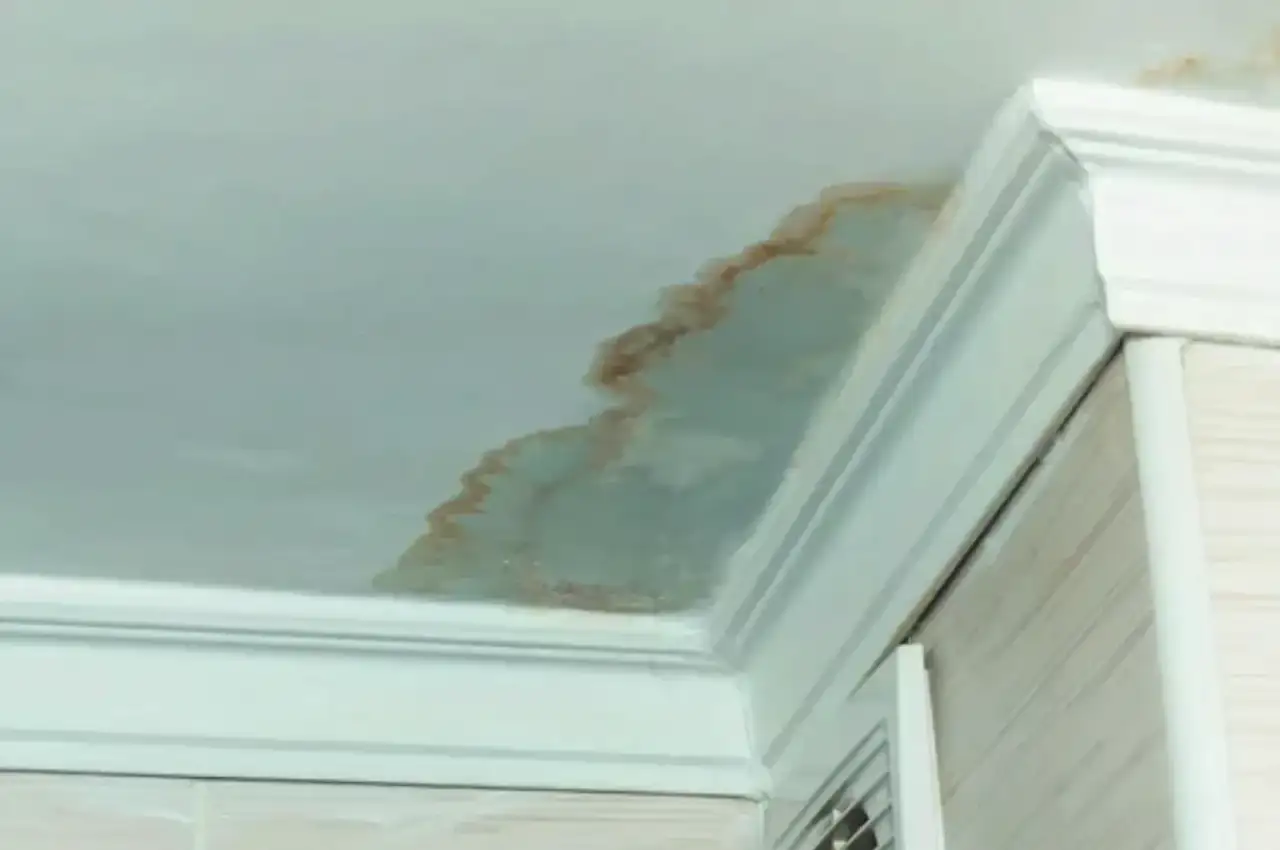
Signs you need this
- • A brown or yellow ring stain on a ceiling or wall, the watermark a leak leaves behind
- • Paint bubbling, blistering, or peeling on a ceiling or wall
- • Soft, spongy, or crumbling drywall when pressed, the board losing its integrity
- • A sagging or bowing ceiling panel holding the weight of trapped water
- • A musty basement smell or visible mold spots, common in Hartford's old fieldstone-and-block basements
- • Peeling joint tape at a seam that used to be tight
Water Damage Drywall Repair in Greater Hartford
A water stain on the ceiling is almost never as small as it looks. By the time a brown ring shows through the paint, the drywall above it has usually absorbed enough moisture that its paper face is compromised, and the cavity behind it may already be damp. Painting over it hides the mark for a few weeks and then it bleeds back, because the problem was never the stain, it was the board. Across Hartford County, water damage is one of the most common urgent drywall calls, and the pattern here is seasonal and predictable: burst pipes in the January and February deep freeze, roof leaks and ice dams on the older housing stock, and Connecticut River high water and spring melt pushing into low-lying and riverfront basements.
Why wet drywall comes out
Gypsum board is a paper-faced material, and once that paper face takes on water it loses its grip and will not hold paint correctly, even after it dries and looks fine. That is the core reason a proper repair removes the damaged board rather than drying it in place. It is also why timing matters. Once the leak is stopped, there is roughly a 24 to 72 hour window before mold begins colonizing the paper face and the framing cavity, and in Hartford’s humid summers, and in the old below-grade basements that never fully dry out, that window is shorter. The right move after a resolved leak is to get the damaged board out within a week or two, not to wait and hope it dries clean.
Old plumbing, old basements, and a hard winter
Much of Hartford’s water damage traces back to the age of the building. In Frog Hollow, the West End, Asylum Hill, Parkville, and Barry Square, a lot of the housing predates 1940, and the galvanized supply lines, cast-iron waste stacks, and original roofs on those homes fail on their own schedule. Winter concentrates it. When a cold snap settles over the metro, water sitting in an uninsulated exterior wall or an unheated crawlspace freezes, expands, and splits the pipe, and the damage often shows up in the ceiling or wall below once it thaws. Fieldstone and block basements add a second front: they wick ground moisture year-round, and when the Connecticut River runs high in spring, low-lying finished basements take on water against the drywall. In any of these settings we reinstall with moisture-resistant board, USG Sheetrock PURPLE, Gold Bond eXP, or CertainTeed GlasRoc, because in this housing stock that is the correct specification rather than an upgrade.
What we actually do on-site
We start with a moisture meter, not a guess. The visible stain is rarely the outer edge of the wet zone, because water travels along joists and pipe runs and into adjacent walls, so we map the real extent before quoting. We confirm the leak source is fixed, because we will not reinstall over an active problem. When the board comes out, what is behind it decides the rest: dry, clean framing means we reinstall, while mold on the framing means we stop, document, and coordinate a Connecticut-licensed remediation contractor, and the wall does not close until an air-quality clearance test passes. Pairing the drywall work with remediation this way keeps the repair from becoming the same job twice.
Insurance, multi-family, and pre-sale
Hartford is the insurance capital, and a lot of its water damage comes with paperwork attached. For homeowners running a claim, we provide itemized scope documentation in the format Connecticut adjusters expect and can be on-site when they inspect. For landlords and building owners dealing with a unit-above leak in a majority-renter city, we coordinate access with building management and document the scope to support a building or HOA claim alongside the owner’s. For sellers, Connecticut property disclosure rules mean a documented, properly executed repair is worth more at closing than a painted-over stain an inspector will flag. In every case the finish is the same standard: board removed, cavity verified, new board reinstalled, finished to Level 4, texture matched, primed, and handed off paint-ready with documentation for the file.
Materials & standards
Products & materials we use
- USG Sheetrock PURPLE (moisture and mold resistant)
- National Gypsum Gold Bond eXP (moisture resistant)
- CertainTeed GlasRoc (fiberglass-mat facing; below-grade and high-moisture)
- Durabond / Easy Sand setting compound; Sheetrock topping compound
Standards & codes we work to
- GA-216 (Level 4 finish standard)
- 2022 Connecticut State Building Code
- CT DCP Home Improvement Contractor registration
- Connecticut property disclosure law (water and mold disclosure at resale)
- Hartford building department (cosmetic repair no permit; structural framing may)
What the terms mean
- Paper face / paper face delamination
- Moisture meter / moisture content reading
- Setting versus topping compound; feathering
- Framing / substrate assessment; air-quality clearance test
- Fastener schedule; backing
Options & variants
| Option | When it applies | Cost |
|---|---|---|
| Surface stain repair (no board replacement) | Only when exposure was very brief, the board is firm, and the paper face is intact; uncommon, assessed on-site | Lower |
| Single panel replacement | One ceiling or wall panel; framing behind it is dry | Mid |
| Multi-panel replacement | Leak spread across panels or joists; common with a bathroom-above leak or a burst-pipe run | Higher |
| Full section plus framing treatment | Mold or rot on the framing; removal, remediation coordination, and reinstall after clearance | Highest |
| Moisture-resistant reinstall (PURPLE / eXP / GlasRoc) | Water-intrusion history, below-grade rooms, multi-family units | Modest material premium; the right call in old basements |
| Insurance documentation scope | Adjuster involved; building or HOA claims | Adds scope-phase time; no material change |
What affects cost
- • Square footage of damaged drywall, the largest single variable: one panel versus a ceiling that spans two rooms
- • Ceiling versus wall: ceilings take more labor because of overhead work, collapse risk, and staging
- • Number of layers: some older Hartford homes have drywall installed over original plaster, and both can come out together
- • Framing and insulation damage: compromised joists, blocking, or wet insulation has to be addressed before any new board goes up
- • Mold presence: triggers separate Connecticut-licensed remediation, and the wall does not close until an air-quality clearance passes
- • Board type: moisture-resistant board (USG Sheetrock PURPLE, Gold Bond eXP, CertainTeed GlasRoc) costs more, and in basements and multi-family settings it is the correct call, not an upsell
- • Finish and texture match: matching knockdown, orange peel, or a hand-troweled finish adds labor
- • Access: high ceilings, furnished or occupied units, and tight multi-family stairwells
- • Insurance documentation: adjuster coordination and an itemized scope add front-end time
Price ranges
Low end
$600–$1,000
Single panel, no framing damage, standard or moisture-resistant board, matching texture
Typical
$1,000–$2,000
2–5 panels, one area, moisture-resistant reinstall, texture match, basic documentation if insured
High end
$2,000–$3,500+
Multi-room or large section, mold coordination, framing treatment plus clearance, multiple finish types, full insurance package
What to expect
- 1
On-site assessment
We inspect the damage, probe the surrounding area with a moisture meter, and check the framing and insulation behind the panel. A ceiling stain is rarely the outer edge of the wet zone; a pipe run or an ice dam can carry water along a joist into the next room. We confirm the water source is resolved, because we will not reinstall over an active leak.
- 2
Scope and quote
A written quote covering board footage, board type, finish level, and any remediation coordination. For uncertain framing, we scope contingently and spell out what changes if mold turns up. Insurance quotes are formatted the way Connecticut adjusters expect, with itemized labor and material and footage broken out.
- 3
Insurance adjuster coordination (if applicable)
For homeowners running a claim, and for landlords and building owners working through property or HOA insurance, we communicate with the adjuster before work starts, provide a claim-supporting scope, and hold to their approval timeline. In the insurance capital, this side of the job is routine for us.
- 4
Removal and substrate assessment
The damaged board comes out. If the framing and insulation behind it are dry and clean, we reinstall. If there is mold, common after a slow basement leak or moisture that sat behind a wall, we stop, document, and coordinate a Connecticut-licensed remediation contractor. The wall does not close until an air-quality clearance passes.
- 5
Mold remediation coordination (if mold is found)
We sequence our work around the remediation contractor and return after clearance, handing you their documentation for your insurer or your records.
- 6
Reinstall
New board goes in: USG Sheetrock PURPLE, Gold Bond eXP, or CertainTeed GlasRoc where the conditions or the history call for moisture resistance, standard board where they do not. Correct fastener schedule, backing at the panel edges, taped seams. In multi-family buildings we coordinate access and debris around tenants and building rules.
- 7
Finish and texture match
Setting-compound base coats, topping finish coats, sanded to a GA-216 Level 4 finish. Existing texture is sampled and test-matched before we apply it, so the repair does not read under raking light.
- 8
Handoff
Primed and paint-ready, with written documentation of the scope, materials, and board type for insurance, records, or a pre-listing disclosure package.
When this isn’t the right call
- If the leak source has not been fixed, we will not reinstall over an active problem. The plumbing, roof, or appliance failure has to be resolved first.
- If mold is extensive in the wall cavity, full remediation comes first, and we coordinate and return after clearance. The better first step is mold drywall replacement.
- If the damage is only cosmetic, a surface stain over firm board with an intact paper face, a stain-blocking prime or a spot skim may be all it needs, and we will tell you that on-site.
- If the ceiling failure is structural, rotted joists need a framing contractor before any drywall, and we refer and sequence around that work.
- If the water damage is widespread beyond the drywall, flooring and cabinetry are separate trades; we handle the drywall scope and document it.
Frequently asked questions
Does water-damaged drywall always need to be replaced? +
Usually, yes. If the board got wet and dried in place, the paper face is likely compromised even when the surface looks fine, and a compromised paper face will not hold paint and will delaminate over time. The exception is very brief exposure with firm board and an intact paper face. We assess on-site and tell you honestly whether it can be saved without full replacement.
Is there always mold behind water-damaged drywall? +
No, but the risk is real once moisture has been present more than 24 to 48 hours or the area has seen repeated exposure. Mold colonizes the paper face and the wall cavity before it ever shows on the surface. In Hartford's old below-grade basements, where humidity stays high, the risk runs higher. We check behind every panel we remove and coordinate remediation if we find mold on the framing.
My basement floods when the Connecticut River comes up. Should I use special drywall? +
Yes. In riverfront and low-lying homes with a history of water intrusion, we reinstall with moisture-resistant board (USG Sheetrock PURPLE, Gold Bond eXP, or CertainTeed GlasRoc) and often keep the bottom of the wall off the slab so the board is not sitting in the next event's water. It is the correct call for that setting, not an upsell.
A pipe burst this winter. Do you work with my insurance company? +
Yes. Burst-pipe damage is one of our most common winter calls in the Hartford metro. We provide itemized scope documentation in the format Connecticut adjusters expect, board footage, material type, and labor, and we communicate with the adjuster directly, including being on-site for the inspection. We work within your adjuster's approval timeline before starting.
The leak came from the unit above me. How does that work? +
We handle multi-family and condo water damage regularly across Hartford and the surrounding towns. We coordinate access and timing with building management, document the scope to support a building or HOA claim alongside yours, and follow building rules on staging and debris.
How long does the repair take? +
Single-panel repairs are often one visit of a few hours. Multi-panel or mold-coordinated jobs run 2 to 4 days with dry time between coats. Insurance jobs add front-end time for approval. We give you a specific timeline in the quote.
Do I need to move out during the work? +
No. We contain the work area with plastic to control dust and protect floors and furniture for overhead removal. You can stay put for most repairs.
Will the patch show after it's painted? +
Not if it is done right, finished to a GA-216 Level 4 standard with seams feathered, fasteners covered, and the area primed before paint. Skipping the prime coat is what makes a repair read after the first coat of paint. We prime before handoff.
Do I need a permit? +
For most water-damage drywall repair, no. If we find structural framing damage that needs framing work, that may trigger a permit under the Connecticut State Building Code, which we identify at assessment. Cosmetic drywall repair on its own does not require a permit through the Hartford building department.