
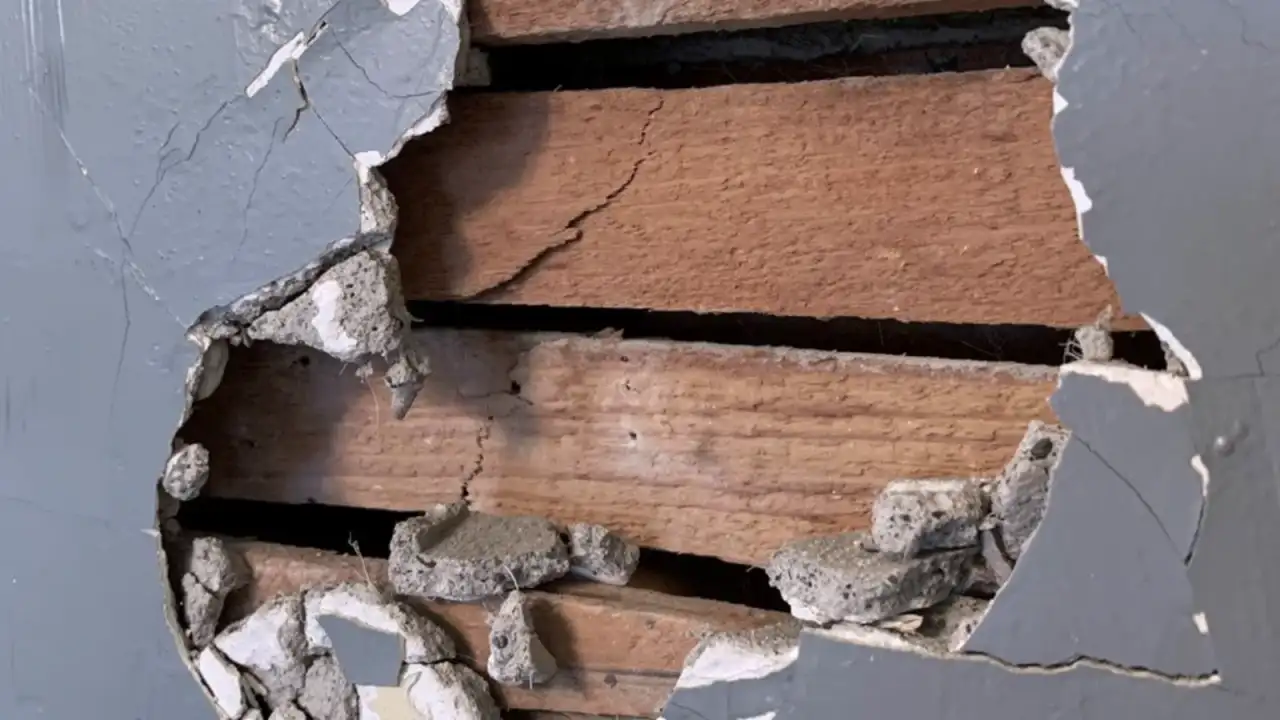
Signs you need this
- • Cracks running through plaster walls and ceilings — hairline spider cracks, long straight cracks over doors and windows, or cracks that keep coming back a season after they were painted over
- • A plaster ceiling that is sagging, bellying down, or has a section that flexes when you push on it
- • Plaster that sounds hollow when tapped — a sign it has "let go" of the wood lath behind it and lost its keys
- • Chunks of plaster that have crumbled or fallen, with the thin wood lath strips visible behind the hole
- • Bubbling, soft, or crumbling plaster after a roof, radiator, or plumbing leak in an older Hartford home
- • Walls that read wavy in raking light, or old patches that never held and cracked again at the edges
Plaster Repair and Plaster-to-Drywall Conversion in Hartford’s Old Homes
Hartford has some of the oldest urban housing stock in Connecticut. Walk through Frog Hollow, the West End, Asylum Hill, Parkville, or Barry Square and you are surrounded by pre-war homes built with plaster-and-lath: wet plaster troweled over thin wood strips nailed to the studs and joists. Frog Hollow’s median build year is 1947 and close to half its homes went up before 1940, and the West End’s Victorians and American Foursquares are older still. It is a dense, solid, beautiful wall system, and after most of a century it cracks, sags, and lets go of the lath. That makes plaster failure one of the most common wall problems in the city, and one of the least well served, because most drywall crews treat every old wall as something to rip out. The first real question is not how to fix it. It is whether to save it.
How plaster fails, and how we read it
Plaster holds to wood lath through keys, the plaster that squeezed between the lath strips and hooked over them while it was still wet. Over decades, vibration, settling, and moisture break those keys, and the plaster field starts to pull away from the lath even when the surface still looks fine. That is why a wall sounds hollow when you tap it, why a ceiling bellies downward, and why cracks come back over the same doors and windows no matter how many times they are painted. We tap and inspect to map where the plaster is still keyed and where it has detached. A crack is usually just the visible edge of a larger area that has let go. Knowing the difference is the whole job, because it decides whether you are stabilizing or replacing.
Repair: saving the original plaster
When the plaster is mostly sound, we save it. Plaster washers, small perforated discs screwed through the plaster into the lath or framing, pull a sagging or loose field back tight and re-secure it without tearing the ceiling out. Cracks get cut open and reinforced with tape or mesh so the movement behind them does not telegraph back through the next coat of paint, rather than just filled. Then the surface is re-skimmed flat and feathered into the surrounding wall. In an old Hartford home, keeping the original plaster and its hard, flat surface is worth the extra care, and it holds the character that a West End or Asylum Hill house is bought for.
Conversion: when drywall is the right answer
Sometimes the plaster is too far gone: widely detached, sagging across a whole ceiling, or already failed and re-patched more than once. Then converting that surface to drywall gives a flatter, more durable result. The trick that separates a clean conversion from an obvious one is thickness. Original plaster is thicker than a sheet of drywall, so if you simply hang board on the existing studs the new wall sits back from the old one and the trim reveals go shallow. On a Victorian or Foursquare, those deep casing and baseboard reveals are part of the house, so we fur the framing out to bring the new board flush with the adjacent plaster, keep the reveals, then skim and feather the transition until you cannot tell where the old surface ends and the new one begins.
Skim or convert, and keeping the trim
A lot of old-home decisions come down to skim versus convert. If the plaster is sound but the surface is tired, wavy, or covered in old paper, a skim coat brings it back without removal. If the plaster has genuinely failed, conversion is the honest call. Either way the goal on a pre-war Hartford home is the same: a flat, durable finish that respects the trim reveals, the plaster profiles, and the proportions the house was built with, not a flat dead patch sitting next to century-old walls.
Living in the house, and lead
Plaster removal is dusty, so we contain the work area and protect floors and furnishings, and because the paint on pre-1978 plaster almost always contains lead, we follow lead-safe (RRP) practices as a matter of course in Hartford’s old homes. Crack repair and stabilization are far cleaner than full removal, and most repairs let you stay in the house. Whether it is a single recurring crack in a Frog Hollow flat, a sagging Parkville ceiling, an Old Wethersfield restoration, or a full conversion as part of a renovation, what you are buying is an honest read on what your plaster actually needs, and a finish that respects the house instead of fighting it.
Materials & standards
Products & materials we use
- Plaster washers (perforated re-securing discs)
- Structo-Lite / gypsum basecoat plaster (for plaster-system repairs)
- USG Sheetrock / National Gypsum Gold Bond / CertainTeed / Georgia-Pacific ToughRock drywall (for conversion)
- Blueboard and veneer plaster (where a plaster-type finish is kept)
- Durabond / Easy Sand setting-type compound; topping compound (blending)
- Paper tape / fiberglass mesh tape (crack reinforcement)
Standards & codes we work to
- GA-214 finish levels and ASTM C840 / C1396 (finishing the drywall portions)
- 2022 Connecticut State Building Code
- EPA RRP Rule (lead-safe renovation in pre-1978 homes)
- CT DCP Home Improvement Contractor registration
- Gypsum Association
What the terms mean
- Plaster-and-lath / wood lath / keys / keying
- Delamination / "let go" / hollow plaster
- Plaster washers / re-securing the field
- Skim coat / brown coat / finish coat / veneer plaster
- Furring / shimming to match plaster thickness and keep trim reveals
- Spider cracks versus structural or settling cracks
Options & variants
| Option | When it applies | Cost |
|---|---|---|
| Crack repair & reinforcement | Stable plaster with cracks; keys still intact | Lower — fill, reinforce, skim, no removal |
| Plaster stabilization (washers) | Plaster pulling from lath but otherwise sound — sagging ceilings, loose fields | Mid — washers, re-secure, skim |
| Partial conversion (one wall or ceiling) | A single surface is too far gone; the rest is sound | Mid — remove, drywall, blend to adjacent plaster |
| Full plaster-to-drywall conversion | Plaster widely failed, or renovation scope warrants it | Higher — full removal, drywall, finish |
| Skim-coat restoration over plaster | Sound plaster with tired surface or old paper | Mid — see Skim Coat & Level 5 Finish |
| Historic-profile & trim-reveal matching | Victorians and Foursquares; keeping casing and baseboard reveals | Premium — careful furring and matching |
What affects cost
- • Repair vs. replace — stabilizing sound plaster is cheaper than removing it and converting to drywall
- • Extent of key failure — how much of the plaster has pulled from the lath decides how much can be saved
- • Ceiling vs. wall — ceilings are more labor because of overhead work, collapse risk during removal, and support
- • Surface area — a single crack and a whole room of failing plaster are very different projects
- • Substrate condition — old wood lath may need removal, or the wall may need furring to bring drywall flush with the original plaster thickness
- • Trim reveals — keeping the deep casing and baseboard reveals on a Victorian or Foursquare means furring the new board out to the old plaster line, which adds labor
- • Finish blending — matching the new surface to the thickness and texture of the original plaster adds skim labor
- • Occupied home and dust control — plaster removal is dusty, and containment in a lived-in old home adds setup
- • Lead-paint era — pre-1978 homes usually have lead paint on the plaster, which triggers lead-safe (RRP) practices
Price ranges
Low end
$1,200–$1,800
Crack repair and reinforcement, or stabilizing a modest area, skimmed and primed
Typical
$1,800–$3,000
Stabilizing a sagging ceiling, or converting one wall or ceiling to drywall, blended and finished
High end
$3,000–$4,000+
Full-room plaster-to-drywall conversion, trim-reveal and profile matching, or multi-room work
What to expect
- 1
Assessment
We tap and inspect the plaster to find where it is still keyed to the lath and where it has let go. A crack is often just the visible part of a larger area that has pulled away. We tell you honestly what can be saved and what is better converted, and why.
- 2
Recommendation: repair or convert
Based on key failure, the substrate, and your goals and budget, we recommend stabilizing the original plaster or converting to drywall. On a Victorian or Foursquare we factor in the trim reveals and any profiles worth keeping.
- 3
Containment
Plaster work is dusty, especially removal. We protect floors and furnishings and contain the work area. In pre-1978 homes we follow lead-safe (RRP) practices, because the old plaster paint in a Hartford home almost always contains lead.
- 4
Repair path
For stabilization, plaster washers re-secure the field to the lath, cracks are cut open, reinforced with tape or mesh as appropriate, and the surface is re-skimmed flat. For crack repair, we address the movement behind the crack, not just the gap, so it does not telegraph back through the paint.
- 5
Conversion path
Failed plaster, and the lath where needed, comes out, the cavity is checked, and the framing is furred out as required to bring the drywall flush with the adjacent original plaster thickness. New board is hung, and trim reveals are preserved rather than buried.
- 6
Blending and finish
The repaired or converted area is skimmed and feathered into the surrounding original surfaces so the transition disappears. Texture or a smooth finish is matched to the existing wall, then primed and left paint-ready.
- 7
Handoff
Surface primed and ready for paint. For pre-sale work, we leave it clean enough to photograph and document. For older homes, casing reveals, profiles, and details are matched to the original.
When this isn’t the right call
- If the plaster is sound and only the surface is tired → A skim coat restores it without repair or replacement. See: Skim Coat & Level 5 Finish.
- If the damage is from an active leak → Resolve the leak and assess for water and mold first. See: Water Damage Drywall Repair / Mold Drywall Replacement.
- If it's a popcorn or textured ceiling you want smooth → That's a removal and refinish scope. See: Popcorn Ceiling Removal.
- If it's a small modern drywall crack, not plaster → A standard patch is the right, cheaper fix. See: Drywall Crack Repair.
- If a ceiling is structurally failing at the joists, not the plaster → That needs a framing or structural look before any surface work.
Frequently asked questions
Should I repair my plaster or just convert it to drywall? +
It depends on how much of it has let go of the lath. If most of the plaster is still keyed and sound, stabilizing and re-skimming it is cheaper and keeps the original surface, which matters in a West End or Old Wethersfield home. If large areas have pulled away, are sagging, or have failed repeatedly, converting that wall or ceiling to drywall gives a flatter, more durable result. We tap and inspect first and give you the honest call, not the most expensive one.
My cracks keep coming back after I paint. Why? +
Because paint and filler do not address what is causing the crack, which is usually plaster moving against failing keys or the seasonal movement common in an old Hartford house. We reinforce the crack so the movement behind it does not telegraph back, rather than just filling the gap, which is why a proper repair holds when a paint-over does not.
What are plaster washers? +
Small perforated discs screwed through the plaster into the wood lath or framing to pull a sagging or loose plaster field back tight and re-secure it. They are the standard, minimally invasive way to stabilize plaster that has pulled from the lath without tearing the whole ceiling out, and they get hidden under the skim coat.
I have a Victorian in the West End. Will converting to drywall ruin my trim reveals? +
Not if it is done right. Original plaster is thicker than a sheet of drywall, so if you just hang board on the studs, the wall sits back and the casing and baseboard reveals get shallow or disappear. We fur the framing out to bring the drywall flush with the old plaster line, which keeps the deep reveals and profiles that give a West End or Foursquare home its character.
Can you match the look of my original plaster walls? +
Yes. When we convert a surface to drywall we fur it out as needed so it sits flush with the thickness of the adjacent plaster, then skim and feather the transition until it disappears. On older and detailed homes we match textures, casing reveals, and profiles to the original.
Is plaster work messy? I am living in the house. +
Plaster removal is dusty, so we contain the work area and protect floors and furnishings, and in pre-1978 homes we follow lead-safe practices because the old plaster paint usually contains lead. Stabilization and crack repair are far cleaner than full removal. You can typically stay in the home.
Is a sagging plaster ceiling dangerous? +
It can be. Plaster that has pulled from the lath is held up by very little, and a wet or heavily detached ceiling section can come down. If a ceiling is sagging or pieces are falling, treat it as urgent and keep people from underneath it until it is assessed.
Do you do the whole old-house refresh, not just the plaster? +
Often, yes. Plaster repair pairs naturally with skim coating tired walls, removing popcorn ceilings, and matching textures, so an old Hartford home comes out uniform rather than patchy. We can scope the surfaces together.