
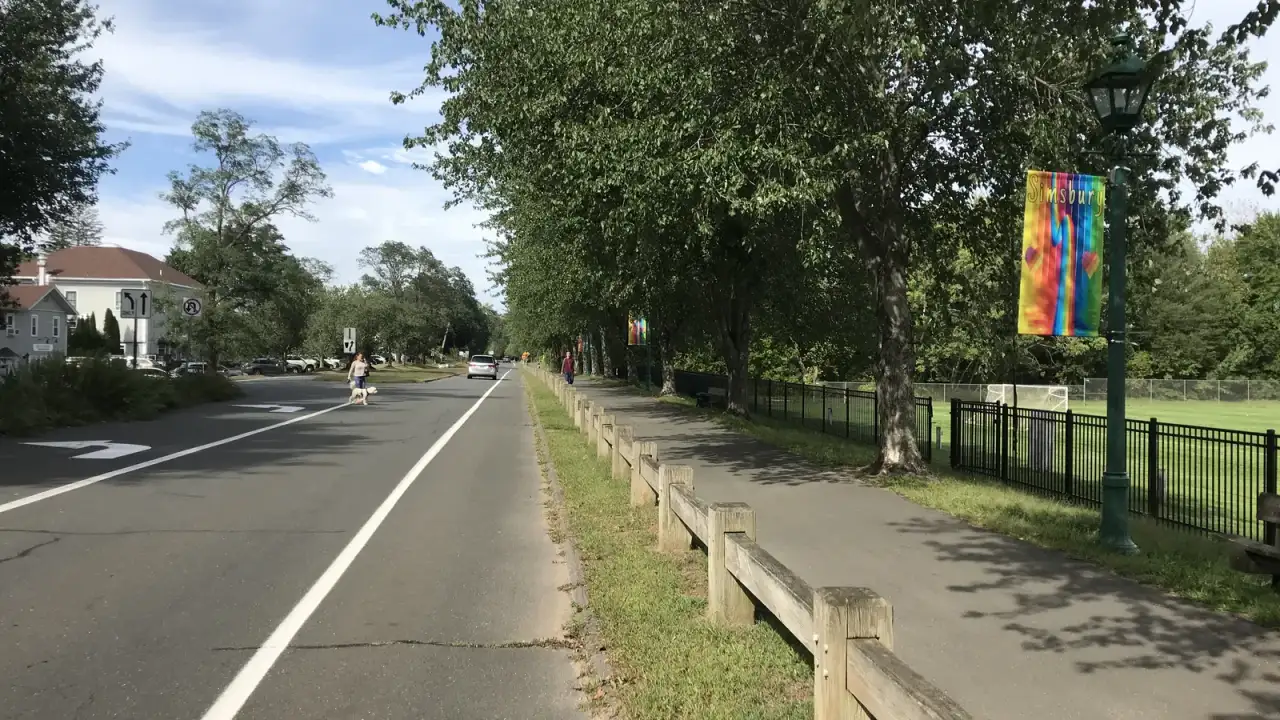
About 14 mi / 22 min NW of Hartford. Same-week scheduling for planned renovation and finishing work; priority visits for active leaks or sagging ceilings.
Drywall and Plaster Repair in Simsbury
Hartford Elite Drywall repairs drywall and plaster across Simsbury, from Level 5 skim coats for the Farmington Valley renovation market to historic plaster repair in Tariffville’s mill housing. Simsbury sits about fourteen miles northwest of Hartford in the Farmington Valley, and it is one of the more affluent, historic towns in the coverage area. The historic town center runs along Hopmeadow Street, anchored by landmarks like the Simsbury 1820 House, with genuine colonial and federal-era homes. Out along the Farmington River sits Weatogue, home to the East Weatogue Historic District, and further north Tariffville, a former mill village tied to the town’s Ensign-Bickford industrial history. West Simsbury and the newer custom-home band round out the town with more recent, high-end construction. That mix of old and new housing stock is what shapes the work Hartford Elite Drywall does here.
Level 5 finishing for the Simsbury renovation market
Hartford Elite Drywall skim-coats walls to a Level 5 finish for Simsbury’s affluent Farmington Valley renovation and custom-build market. Homeowners doing a kitchen remodel, a primary suite addition, or a full custom build expect walls with no visible seam or texture under raking light, which is what a true Level 5 skim coat delivers. This is a different standard than a basic patch job, and it is the finish level a lot of Simsbury renovation work is held to.
Plaster repair on Hopmeadow Street and in Tariffville
Hartford Elite Drywall stabilizes and skim-coats historic plaster along Hopmeadow Street and in Tariffville, where the historic center carries true colonial and federal-era plaster over lath and the East Weatogue Historic District has its own stock of older homes with the same construction. Tariffville’s mill-village housing, built up around the Ensign-Bickford works, is older too, with original plaster and lath in a lot of the worker housing that has survived. In both areas, cracked or failing plaster needs plaster-specific repair, stabilizing what is sound and skim-coating it back to a flat finish, rather than cutting it out for a drywall patch that never quite matches the surrounding wall. The East Weatogue Historic District Commission reviews exterior changes visible from a public way, not interior repair, but homeowners there generally want interior finishes kept true to the home’s period character anyway.
Basement finishing and water-damage repair in West Simsbury
Hartford Elite Drywall finishes basements in West Simsbury and the surrounding custom-home band, newer construction where a steady share of that work comes from. The Farmington River itself runs through both Simsbury Center and Tariffville, and both areas have seen high water, so near-river homes are also where the company sees water-damaged board and hidden mold behind walls after a storm.
Neighborhoods we work in
- Hopmeadow Street / Simsbury Center — The historic main corridor, home to the Simsbury 1820 House and the town's oldest colonial and federal-era houses.
- Weatogue — Older neighborhood along the Farmington River, home to the East Weatogue Historic District.
- Tariffville — Former mill village tied to the Ensign-Bickford industrial history, with older worker housing and mill-era plaster construction.
- West Simsbury — More rural and suburban, with newer high-end custom homes typical of the Farmington Valley market.
Why Simsbury homes need what they need
Simsbury's Farmington Valley market runs affluent, with high-end renovations and custom builds along Hopmeadow Street and in West Simsbury
Buyers here expect flat, flawless walls that show no seam or texture under raking light, driving demand for true Level 5 finish work
The historic center along Hopmeadow Street and the East Weatogue Historic District carry true old colonial-era plaster over lath
Cracked or failing old plaster needs plaster-specific repair and profile matching, not a generic drywall patch
Tariffville's mill-village housing, tied to the Ensign-Bickford industrial history, includes older worker homes with original plaster and lath
This older housing stock behaves like the historic center's, with plaster that needs stabilizing and skim-coating rather than tear-out
West Simsbury and the newer custom-home band have a large stock of postwar and recent construction
Newer homes are the ones getting basements finished, a steady source of drywall work distinct from the older repair jobs
The Farmington River runs through Simsbury Center and Tariffville, both with mapped flood exposure
Near-river homes see water-damaged board and hidden mold behind walls after high water
What we’re called for most in Simsbury
Local resources for Simsbury homeowners
- Building / Permit Dept — Located at 933 Hopmeadow Street, along the town's historic main corridor.
- Assessor / Property records — Assessor records are the local source for housing-era data used in planning renovation work.
- FEMA flood map — Relevant along the Farmington River corridor through Simsbury Center and Tariffville.
- Historic District Commission — Oversees the East Weatogue Historic District and reviews exterior changes visible from a public way.
Frequently asked questions
My house is in the East Weatogue Historic District. Does the Historic District Commission need to approve interior plaster or drywall repair? +
No. The commission reviews exterior changes visible from a public way, not interior work. That said, Hartford Elite Drywall keeps interior finishes true to the home's period character, which usually means repairing and skim-coating original plaster rather than defaulting to a flat drywall patch.
Can you get walls flat enough for a high-end renovation in Simsbury? +
Yes. Hartford Elite Drywall applies a true Level 5 skim coat, which removes visible seams and texture under raking light or strong window light, the standard a lot of Simsbury's renovation and custom-build work is held to.
We're in Tariffville in an older mill-era house. Is our plaster different from newer drywall? +
Likely yes. Tariffville's older housing, tied to the village's mill and Ensign-Bickford industrial history, was largely built with plaster over lath rather than drywall. Hartford Elite Drywall responds with a different approach there: stabilizing and skim-coating the original plaster rather than cutting it out.